Which checkout approach should you start with?
For a web-based SaaS MVP with straightforward subscription plans, start by evaluating hosted checkout and a hosted customer billing portal. Build custom billing screens when a specific buying workflow cannot be handled well by those tools. The first decision is which subscription experience the product needs, not how many payment screens the team can design.
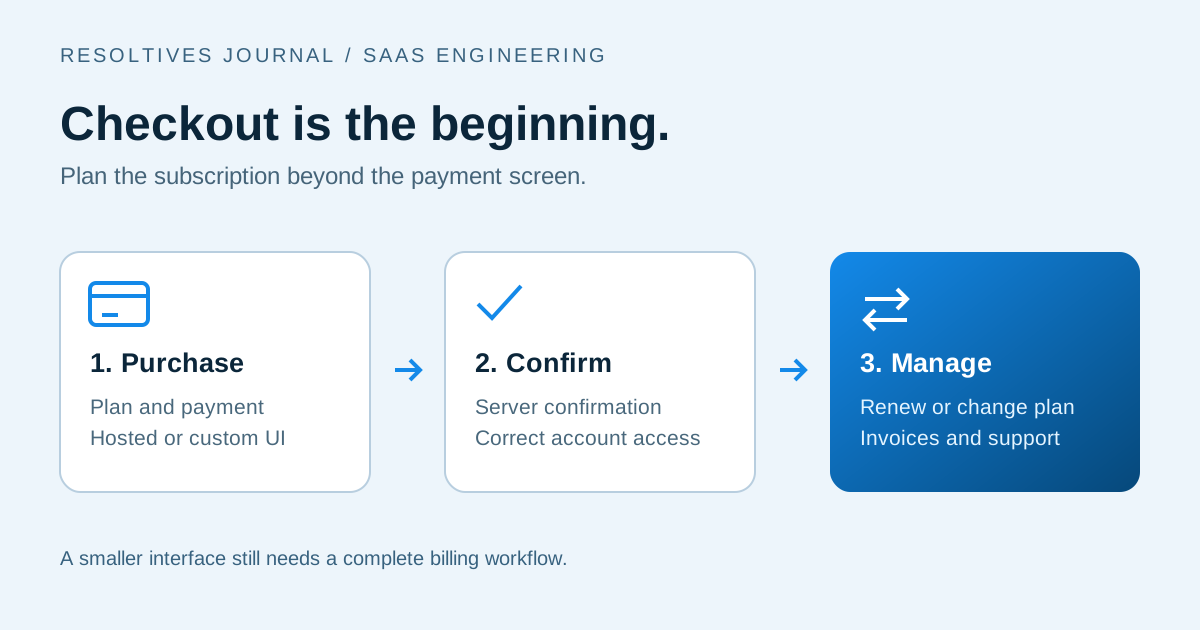
This is a scope recommendation, not a promise of a particular saving or conversion rate. The checkout interface is only part of the work. Your application still needs to connect the paying customer to the correct account and apply the agreed access rules when subscriptions change.
What changes between hosted, embedded and custom checkout?
Stripe’s checkout documentation distinguishes a prebuilt full-page experience, embedded options and custom interfaces built with Elements. These approaches provide different levels of control over the payment UI. Here is how we would frame the commissioning decision for a subscription product.
| Approach | A reason to choose it | Work that remains yours |
|---|---|---|
| Hosted checkout | A focused subscription purchase where a redirect is acceptable | Plan selection, account mapping, access rules and return states |
| Embedded prebuilt checkout | The payment experience needs to stay within the product page | Integration, responsive layout, error states and subscription handling |
| Custom interface using provider components | A defined buying workflow needs more interface control | Additional interface implementation, accessibility, testing and maintenance |
Which pricing decisions must be settled first?
Write a short billing policy before designing the flow. Decide whether one person or an organization pays, whether a plan includes a fixed number of seats, when access starts and what happens when payment is late. Even a single paid plan needs explicit cancellation and renewal behavior.
If the MVP is testing demand for one workflow, ask whether several tiers, usage meters, credit balances and negotiated contracts are essential to that test. Each additional model creates more states to explain and verify. Keep a future pricing idea separate from a launch requirement.
- Which person has permission to buy, change or cancel the organization’s plan?
- Is a trial available, and what access remains when it ends?
- Does a plan change take effect immediately or at the next renewal?
- What happens to existing data and team members after a downgrade?
- Which countries and currencies are part of the first release?
Does the success page prove that the customer has paid?
No. Stripe’s fulfillment guide explains why access cannot depend only on the customer reaching a success page: the browser can close or lose its connection after payment. The server needs a dependable confirmation path and must avoid fulfilling the same purchase more than once.
The return page should describe the actual state. If confirmation is still being processed, say that and provide a way to check again. A payment button followed by a congratulatory screen is not sufficient evidence that the correct workspace has received the correct subscription.
What must keep working after the first payment?
Stripe’s subscription webhook guidance covers events such as payment failures and changes in subscription status. Your product needs rules that turn those events into the appropriate access and customer messages. Agree the grace period and cancellation behavior with the business rather than leaving those choices to an error handler.
Stripe also documents duplicate events and delivery ordering. The implementation should verify event authenticity, handle repeated delivery safely and avoid assuming every event arrives in the order it occurred. Include recovery and reconciliation in the scope so the team can investigate an account whose billing and access disagree.
Do you need to build an invoice and cancellation area?
Check the provider’s portal before commissioning one. Stripe’s customer portal can let customers manage payment methods, view invoices and change or cancel subscriptions, depending on configuration. Evaluate those features against the policies you actually want to offer.
The application should still make the route to billing easy to find and limit it to the appropriate account role. Decide how customers get help when a change cannot be completed through self-service. A custom billing area is justified by a gap in the required workflow, not simply by the existence of another screen in a design file.
What should you see in the launch demonstration?
Ask for a test journey that includes failures and later changes, not just a successful first purchase. This checklist is a suggested acceptance brief; tailor it to the chosen provider and product rules.
| Test | Expected behavior to agree |
|---|---|
| Successful first subscription | The correct account gets the purchased access once |
| Browser closes after payment | Access can recover without another charge |
| Repeated or delayed event | No duplicate access grant and no misleading final status |
| Renewal payment fails | The agreed grace period, notice and access rule apply |
| Downgrade or cancellation | Timing, data availability and any seat limits are explained |
| A normal member opens billing | Billing changes remain restricted to authorized roles |
How should you compare the cost?
Request separate figures for integration, interface design, subscription logic, testing and ongoing support. Provider charges are separate from development fees. Check the provider’s current terms and pricing for the business’s country, payment methods, currencies and selected products before agreeing the total.
This guide concerns web SaaS checkout. If you also sell digital access through an iOS or Android app, assess the applicable store rules and storefronts as a separate requirement. A web checkout decision does not settle an app-store payment flow.
What should you bring to a SaaS billing discussion?
Bring a draft plan table, the account roles, the countries you intend to serve and the changes customers must be able to make themselves. Our SaaS development team can turn that into an implementation scope and test plan. If the product itself is still taking shape, begin with our SaaS MVP planning questions.
Sources and further reading
These official resources support the technical guidance in this article.
Put the thinking
into your project.
Tell us what you are planning. We can help turn the requirements into a clear scope.