What makes a website handover complete?
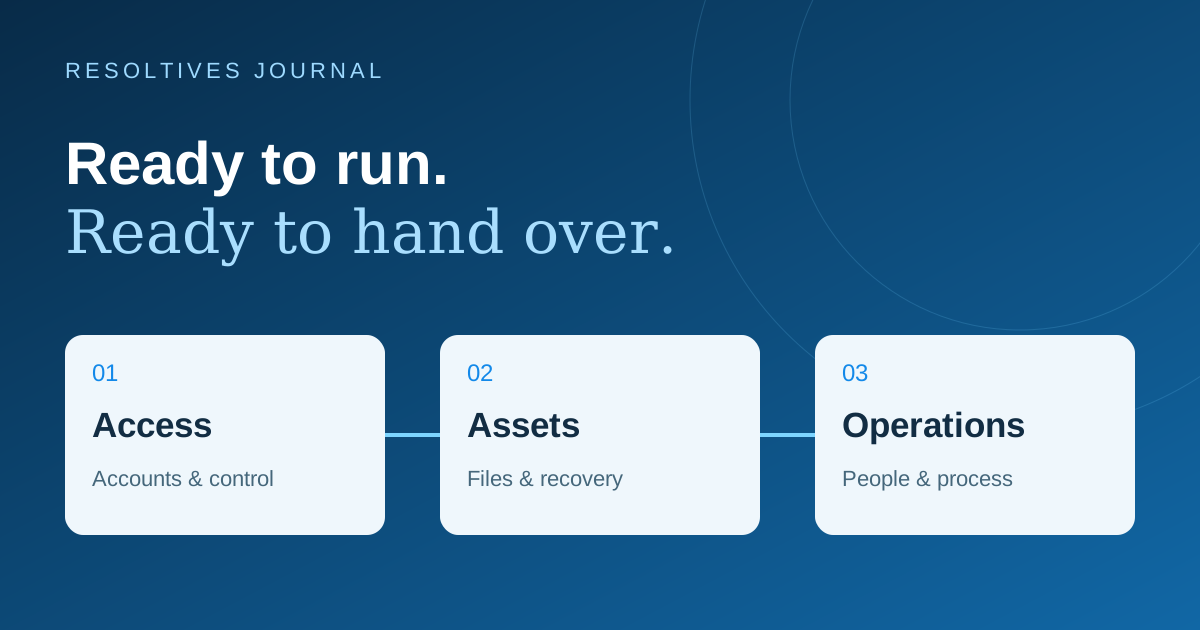
You should receive the access, agreed files and operating instructions needed to run the website without relying on one person’s memory. That normally means a named account owner, access to the relevant services, the deliverables listed in your agreement, a recovery plan and a clear record of ongoing charges. A link to the live homepage is only one part of the handover.
The useful test is practical: can someone on your team update a page, check an enquiry and identify who to contact if something breaks? For a custom site, can the next developer build and deploy the agreed source? Make those demonstrations part of the delivery checklist before launch.
Which accounts should your business be able to control?
Start with an inventory. A domain registration, hosting subscription, website editor and business email may be managed in different places. Give each service a business contact, a billing contact and a named person responsible for recovery. Record where access is granted; do not put passwords or recovery codes in an ordinary project document.
Company-controlled accounts with individual team access are a useful default. An agency-managed hosting arrangement can also work, but its support, export and exit process should be explicit. Ask what would happen if either party ended the maintenance agreement.
| Item | What to record | A useful acceptance check |
|---|---|---|
| Domain and DNS | Registrar, renewal responsibility and where DNS is managed | An authorized team member can view the domain and renewal details. |
| Hosting or website platform | Account owner, plan and deployment method | The team can reach the dashboard or documented support route. |
| Website administration | Who edits, publishes and manages users | A staff member updates a draft without developer assistance. |
| Email and enquiry delivery | Mailbox provider, form destination and integration owner | A labeled test reaches the intended inbox. |
| Search and measurement | Existing property or account access and responsible contact | The team can open the correct property without creating a duplicate. |
Do you need source code, an export or both?
The answer depends on how the website was built. A custom application needs the agreed source, dependency versions, build instructions and deployment configuration. A hosted website builder may instead rely on platform account access, with export options defined by that platform. Ask the agency to name the delivery format rather than promising a vague “complete website backup.”
For WordPress, the built-in export produces a WXR/XML file containing content such as posts and pages. Treat that as a content export, not the whole recovery package. WordPress’s backup guidance separately covers site files and the database. Ask for the backup location, what it contains and a demonstration that it restores correctly. See the WordPress export documentation and backup guidance.
If the source is on GitHub, a repository transfer preserves commit history and associated items such as issues. It also keeps associated secrets, deploy keys and webhooks. Review those connections and collaborator access during the handover instead of assuming a transfer disconnects the former team. GitHub describes these details in its repository transfer documentation.
Which design files and subscriptions belong on the list?
Request the agreed editable design files, final logos, image assets and content documents. Keep a separate list of fonts, stock media, premium plugins, themes and other paid tools. For each item, record whose account supplies it, what happens at renewal and whether a replacement license will be needed after the engagement.
Account control, possession of a file and permission to reuse it are separate questions. Put the intended deliverables and permitted uses in the agreement before work starts. Do not assume every tool used by a designer or developer becomes a transferable client asset.
What should the handover demonstration include?
Use a short demonstration built around the tasks your business actually performs. For example, a service website team might need to update a service description, replace a photograph and check a new enquiry. An online store adds different tasks, such as updating product availability and reviewing an order. Agree on these acceptance exercises before delivery.
- Have your team perform a routine content edit using its own account.
- Send a labeled test enquiry and confirm the receipt and destination.
- Check the key journey on a phone, including menus, forms and confirmation messages.
- Identify the latest backup and demonstrate recovery in a separate test environment.
- For custom builds, show a documented build and deployment from the delivered source.
- List unresolved issues, their owners and the agreed next review point.
What continues after the website is delivered?
Separate delivery from ongoing operation. Record who handles hosting renewals, software updates, backups, content edits and urgent faults. A support agreement should explain its coverage and response arrangements; adding a new feature is different from correcting something that did not meet the agreed scope.
For each recurring service, note the provider, billing frequency, currency, account owner and renewal date. Use the actual invoice or provider quote instead of an assumed monthly cost. If you are comparing a small first site with a larger build, our starter website scope guide explains why the build price and ongoing expenses should be discussed separately.
Does a handover mean moving the domain or email?
No. First identify what actually needs to change. Giving a business access to its existing accounts is different from migrating hosting, changing DNS or replacing its email provider. If a move is necessary, include a plan for existing email, redirects, forms and the route back if a launch check fails.
A redesign also needs a URL and content handover. Keep the old-to-new page map with the project records; our website redesign checklist covers the search-related launch checks in more detail. For a website development project, bring your current platform and the tasks your team needs to handle after launch. Those two details make a handover scope much easier to agree.
Sources and further reading
These official resources support the technical guidance in this article.
Put the thinking
into your project.
Tell us what you are planning. We can help turn the requirements into a clear scope.