Is a mobile-friendly booking website enough?
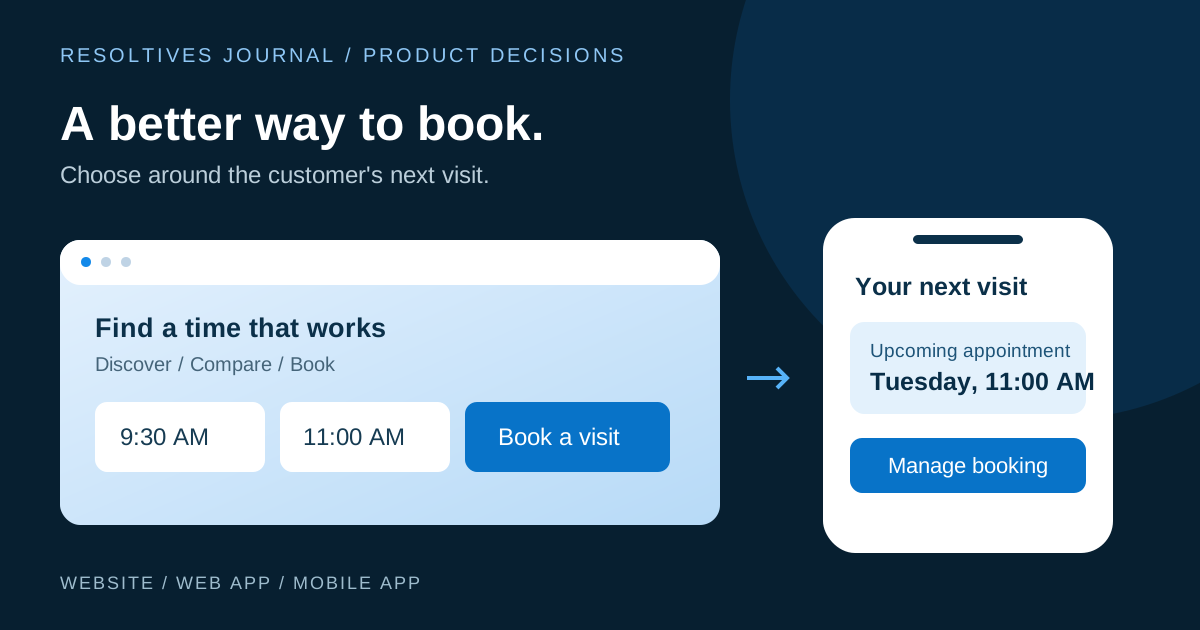
Often, yes. Keep a mobile-friendly website as the main booking route when customers primarily need to discover your service, compare availability and make an occasional appointment. Consider a mobile app when returning customers have a recurring task that the website handles poorly, and you can explain why they would install and keep the app.
For example, a member who manages several classes each week has a different routine from a visitor booking a one-off consultation. The decision should start with that routine, the friction in it and the cost of maintaining another product. An app icon alone does not establish a reason to return.
What problem would the app actually remove?
Watch the current booking journey on a phone before commissioning a replacement. Can someone see the total price, choose a location, understand the time zone and reschedule without calling? Does a returning customer need to enter the same details again? Fixing those problems in the website may be the most useful first project.
Separate customer friction from staff friction. If staff spend time reconciling two calendars, a new customer interface will still need a reliable connection to the booking system. If cancellations are hard to manage, define the cancellation rule and available alternatives before designing another screen.
- Name the task people repeat and how often they repeat it.
- Record where they get stuck using observed sessions or support questions, with personal details removed.
- Identify the system that owns availability, bookings and customer accounts.
- Choose a measurable improvement, such as fewer manual rescheduling requests, and record the baseline before launch.
Should you choose a website, a web app or a mobile app?
These are starting points for a scope discussion. A well-built website and a mobile app can share the same booking service; the customer should not have to maintain separate reservations in each.
| Your main need | Starting point | What to establish first |
|---|---|---|
| New customers comparing services and booking occasionally | Responsive booking website | A clear mobile journey and dependable availability |
| Returning customers wanting quicker access to familiar tasks | Evaluate a Home Screen web app | Whether customers will install it and which features work on their devices |
| A frequent member workflow with a specific device integration | Evaluate a dedicated mobile app | A technical trial of that integration and a reason to return |
| Staff coordinating locations, capacity and exceptions | Booking backend or operations interface | Rules, permissions and the source of truth for bookings |
Do reminders require a native app?
Not necessarily. WebKit documents Web Push for Home Screen web apps on iOS and iPadOS from version 16.4. The customer must add the web app to the Home Screen, and the permission request must follow a direct interaction, such as tapping a subscribe button. A normal visit to a website is not the same as completing those steps.
Treat reminder delivery as a workflow to test. Show the appointment inside the account, explain notification choices and decide what happens if permission is declined. For time-sensitive changes, agree an appropriate alternative communication route and its consent requirements. Do not base the whole service on an assumption that every customer will accept push notifications.
What belongs in the first version of a booking app?
A useful first release might let an existing customer sign in, see upcoming appointments, book again, reschedule within the agreed policy and contact the team. Membership credits, waitlists or check-in belong in the first release only when they are central to the actual customer journey.
An illustrative fitness studio brief could prioritize class availability and membership balance before a social feed. That is a planning example, not a client case study. The same approach applies to other booking businesses: prove the essential transaction before adding reasons to browse. Our fitness application service describes related member and program workflows.
- Availability changes while two people attempt to book the last place.
- Payment succeeds but the customer closes the app before the confirmation appears.
- A customer changes location or time zone before viewing an appointment.
- A cancellation affects a credit, refund or waitlist position.
- The connection drops: distinguish a saved request from a confirmed booking.
Can you just put the existing website in the App Store?
Do not assume a website wrapper will be accepted. Apple’s minimum functionality guideline expects an experience with utility beyond a repackaged website. Define the app’s useful difference before paying for store packaging.
Payment design also depends on what you sell. Apple’s rules for goods and services consumed outside the app distinguish them from digital purchases. An in-person booking and an in-app library of recorded content can require different treatment. Review the actual product, platforms and target storefronts before choosing the payment flow.
What should the estimate include beyond the screens?
Ask for separate scope for the booking integration, account handling, payments, notification delivery, staff tools, device testing and releases. Identify any recurring provider charges and who owns the developer accounts, source code and customer data. A credible estimate names the booking system and checks its integration options first.
For the technology choice, read our native versus cross-platform guide. For the written deliverables, use the app proposal checklist. Neither the framework nor the number of screens tells you the full cost of keeping the booking workflow working.
What is the smallest useful next step?
Write down the current booking tool, the customer’s recurring task, the main difficulty and the budget available for improving it. Bring those details to a mobile app development discussion. We can compare an app with a targeted website improvement and define the smallest useful first release.
Sources and further reading
These official resources support the technical guidance in this article.
Put the thinking
into your project.
Tell us what you are planning. We can help turn the requirements into a clear scope.