How many roles should the first version have?
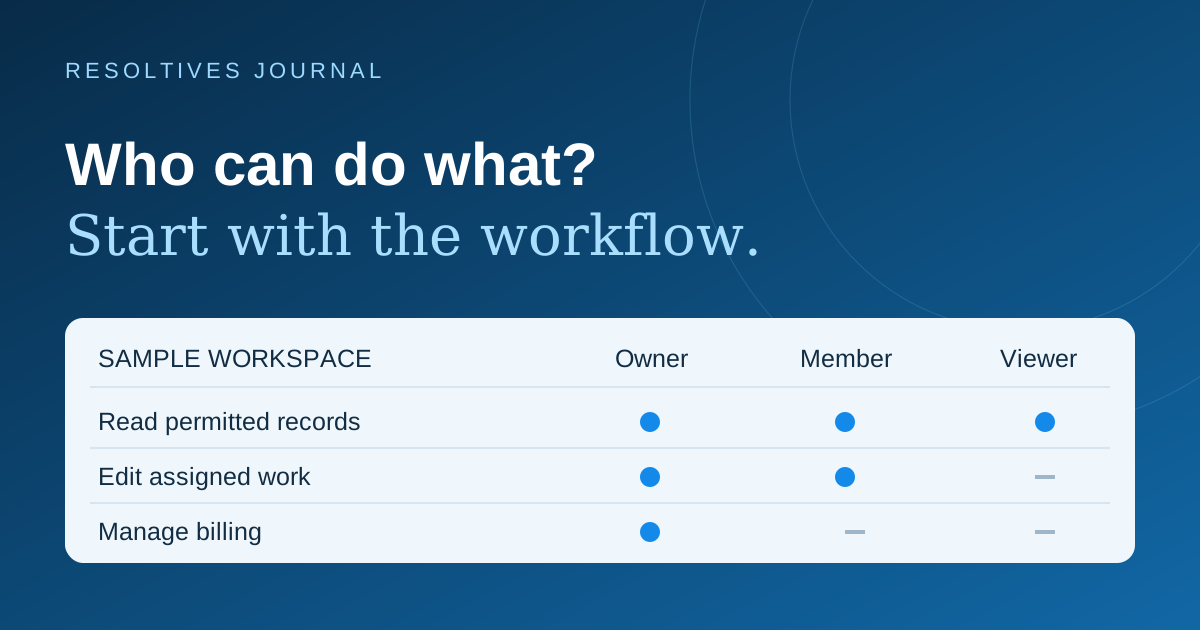
Use the fewest roles that match genuinely different responsibilities in the first release. For a team-based B2B product, a workspace owner and a working member can be a useful starting point. Add a viewer only if someone needs to inspect work without changing it. These are planning options, not a universal three-role requirement.
Before naming roles, list the decisions that matter: who can invite people, change records, download data, manage payment details and close the workspace? If two groups need different answers, that difference belongs in the scope. The role labels should summarize the rules, not substitute for them.
What does a useful permission matrix look like?
Here is an illustrative starting matrix for a shared project workspace. Adjust it to the actual workflow: a member of a sales tool, for example, might be limited to assigned accounts rather than all records in the workspace.
| Action | Workspace owner | Member | Viewer |
|---|---|---|---|
| Read project records | Own workspace | Assigned or permitted records | Explicitly shared records |
| Create and edit work | Yes, within workspace rules | Yes, within assigned scope | No |
| Invite people or change roles | Yes | No, unless separately granted | No |
| Manage subscription and payment details | Owner or separate billing contact | No by default | No |
| Export records | Define an explicit export rule | Only if the workflow requires it | Not automatically included |
| Delete the workspace | Owner, with a deliberate confirmation step | No | No |
Is signing in enough to protect customer data?
No. Authentication establishes identity; authorization determines which actions that identity may perform. Hiding a button does not enforce a permission. OWASP recommends denying access unless it is allowed and validating permission on every request. The check belongs at the protected operation, not only in the page layout. See the OWASP authorization guidance.
In the brief, describe both allowed and blocked behavior. “A member can edit assigned projects but cannot change subscription settings” is more useful than “add a secure member dashboard.” It gives the designer, developer and reviewer the same acceptance criteria.
How do roles work when several companies use the product?
A role needs a customer or workspace boundary. Being an owner of one company’s workspace should not make someone an owner of another company’s data. OWASP’s multi-tenant guidance calls for server-verified tenant context and protection against access across those boundaries. That applies beyond the visible record page, including files, exports and background work. See its multi-tenant security guidance.
Define what happens when one person belongs to two workspaces. The interface should make the active workspace clear, and the access rules should still work if the person changes a URL or opens an old link. Ask for that case in the launch demonstration; do not rely solely on the appearance of a workspace switcher.
Should billing and support access be separate?
Often, yes. The person paying for a subscription may not need to read every project record. Decide whether billing is an owner responsibility or a separate permission. Also distinguish a product plan from a user role: purchasing a feature does not decide which team members may operate it. Our SaaS checkout guide covers subscription and billing interface decisions.
Your own support team is a separate access case. Write down which information staff need, how access is approved and what actions are recorded. If an impersonation feature is proposed, ask why it is needed and scope its controls explicitly. A customer-facing owner role should not quietly double as unrestricted platform administration.
Does a managed backend handle these rules automatically?
A platform supplies enforcement tools, but the product team still has to define and test the rules. For example, Supabase documents Row Level Security as database policies that control row access. Its administrative secret keys can bypass those policies and must not be exposed in the browser. That is an implementation detail your developer should account for, not evidence that any app using the platform is secure by default. See the Supabase RLS documentation.
You do not need to choose a database policy design before an initial scoping call. You do need to explain which people, records and actions belong together. A useful proposal turns those business rules into an implementation and a reviewable test plan.
What happens when someone joins, changes role or leaves?
Permissions are not a one-time setup screen. Agree who can invite someone, whether an invitation expires and who can withdraw it. Decide what happens to a person’s assigned work when access is removed, and how the last workspace owner is replaced without leaving the customer stranded.
Role changes should have an explicit effective point. Ask the team to demonstrate that a removed user cannot keep performing protected actions through an already-open tab. For important changes such as assigning an owner or exporting records, define the event details the product needs to retain for support and review.
- Try each role with an account created specifically for testing.
- Use two separate customer workspaces and check that neither can read the other’s records.
- Try restricted actions directly, not only through visible buttons.
- Change a member’s role during a session and test the next protected action.
- Cancel a pending invitation and confirm that it cannot grant access later.
- Check that shared links and exports follow the intended access rules.
What can wait until after the MVP?
A flexible role builder, per-field rules and a complex approval hierarchy can often wait if the first customer workflow does not need them. A clear customer boundary and enforced access rules cannot be replaced by a promise to add security later. Keep the first role set small, but make its behavior complete.
Use our SaaS MVP planning guide to connect this matrix to the broader first-release scope. For a SaaS development discussion, bring a list of user types and five actions that should be restricted. That is a practical starting point for estimating the work, including design, implementation and testing.
Sources and further reading
These official resources support the technical guidance in this article.
Put the thinking
into your project.
Tell us what you are planning. We can help turn the requirements into a clear scope.